
Facial Reconstruction
Advised by director of forensic pathology
Work as an individual research assistant
New Taipei City, 2015
A research institute under the direction Ministry of Justice; researches pathology, toxicology, and serology; provides professional training and consultation.
Challenge
Catastrophes such as plane crash, earthquake etc, cause large numbers of death in a short period. Tradition anatomical method is rigorous however considerably slow and unpractical in these situations.
Since estimation of many variables should be done in severely damaged bodies, significant errors are detected by utilizing existing methods. For example, a critical factor of how a person looks depends on the stretchiness of the skin. However, after a human dies, it is challenging to reinvent the stretchiness. Moreover, anonymous dead are often found only skeleton remains which require additional complicated reconstruction process. Thus, in this project, a new method providing forensic doctors a rapid way of identification is introduced.
Process
Background
In Taiwan, every man is obligated to serve in the military or governmental department for one year, which I served as a research assistant in the National Institute of Forensic Medicine. Without domain knowledge in Forensic Science, I was curious about all the instruments in the laboratory. I found 3D scanner and printer in one of the lab and started wondering about the purpose of owning these fancy maker stuff. So I proactively inquired the forensic specialists and noticed those equipments were meant to use for facial reconstruction, however, were left in the lab since no one is available due to heavy work load. Thus, I stepped up volunteering this facial reconstruction project.
Research
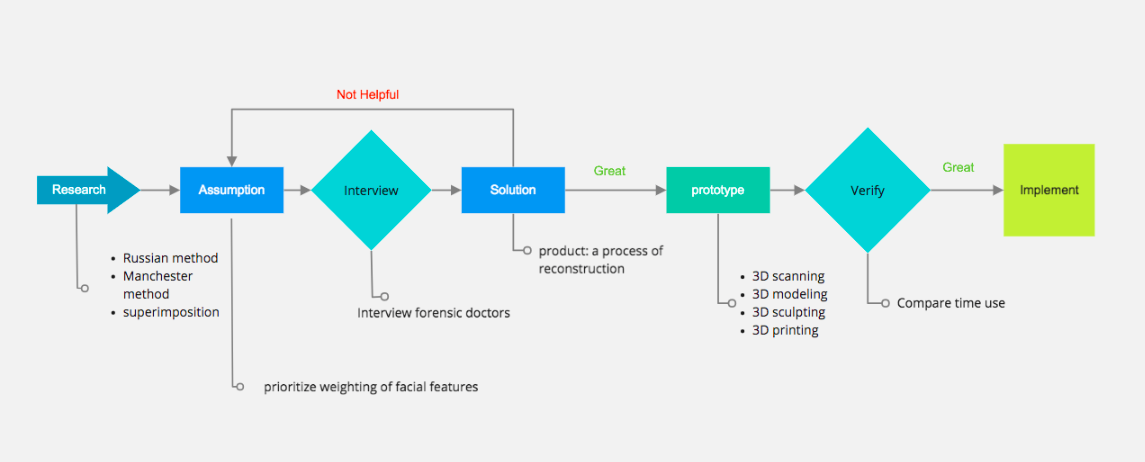
I read through forensic medicine research papers and interviewed forensic doctors and specialist questions regarding these aspects:
- Why do facial reconstruction
- What situation do you need facial reconstruction?
- What are the challenges?
- Why turn to technology?
The answers are what I mentioned above in the first paragraph - facial reconstruction is used in the identification of severely damaged bodies. However, the traditional facial clay model takes a well-trained forensic artist up to 6 hours to complete. In contrast, the digitalized process still takes more than 3 hours, which makes the technique unpractical in catastrophic situations with a lot of dead.
To understand existing method, I read through forensic art and facial reconstruction papers. I found many processes could be done faster with data and modularized features since the purpose of reconstruction isn't making the model extremely high fidelity, but to make it identifiable to the forensic doctors. Therefore, finding out and prioritize what are the key features for the forensic doctor to identify anonymous dead is the first step.
Also, I spent more than eight months to conduct contextual enquiries for familiarizing the autopathy process, from receiving cases, scene investigation, autopathy practice, sample examine, identity recognition, and report formation. The effort enables me to collect a huge amount of raw data for further solution design.
At the meantime, I participated in the "CT-Scan Database for the Facial Soft Tissue Thickness of Taiwan Adults" project that I assisted on collected more than 500 Taiwanese Adults soft tissue data. From these data, I come up with the idea that "why don't we just apply the normal distributed soft tissue on the depth marker before spending a lot of time examining the actual depth by the skeletal remain evidence?"
Solution
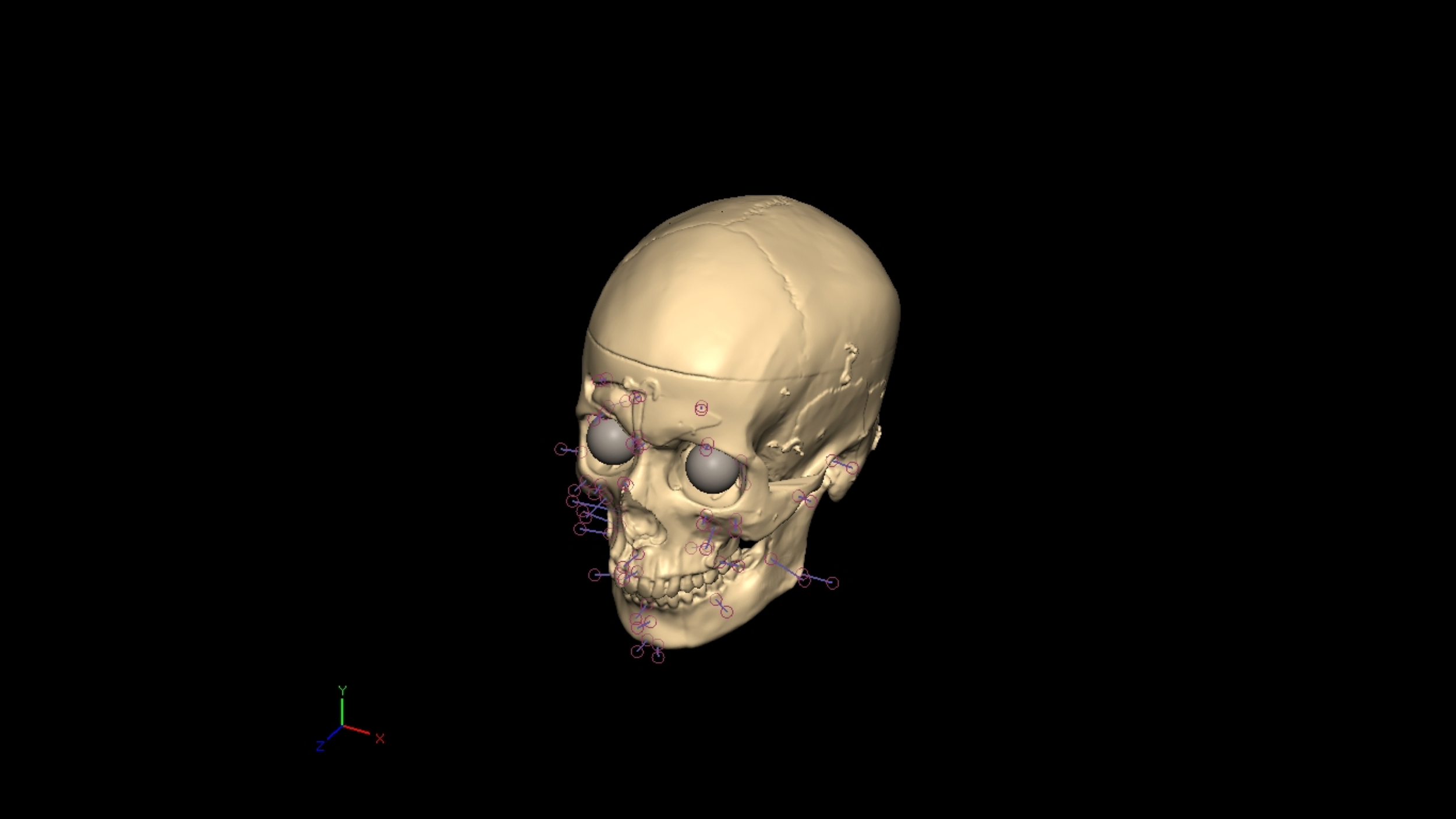
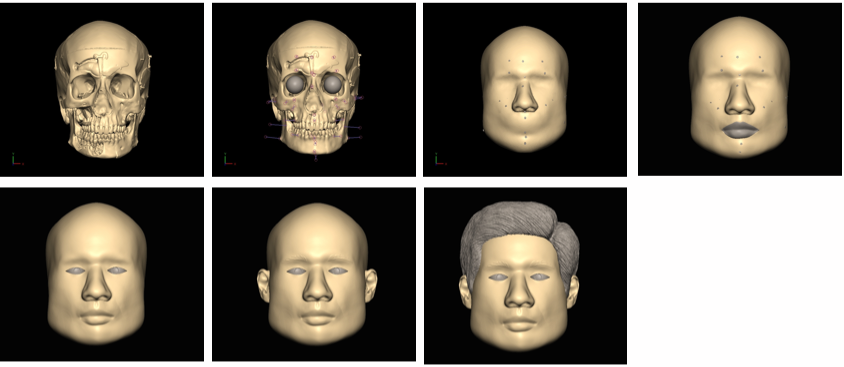
- Scan the skull to construct 3D model
- Repair broken part
- Set 14 depth markers
- According to the statistics derived from research, apply soft tissue layer to the face
- Smoothing
- Add on modularized face feature, iterate through different combinations.
Result
The entire process could be broken down into several parts: preprocessing, model construction, facial reconstruction, face mapping, and cross-identification. In the past, facial reconstruction took forensic technicians hours of training in forensic art and software operation before spending an average of 6 hours reconstructing a face. The method I designed only requires the minimum knowledge of forensic art and software technics. By normalizing and modularizing, the method decreases the time of reconstructing a face to 45 minutes, which meet the need of forensic team - rapid identification. Now, this technique is taught to every new staff responsible for facial reconstruction in the institute of forensic medicine.
Future
There are a few things could be improved in the future. First, construct a 3D model by cell phone camera. In the past computer vision API isn't popular, but now, Google, Amazon, and IBM all got powerful CV API ready to use. Forensic doctors could then send in the model when they are still in the field. Forensic technicians could operate at first hand. Second, automation of the process is another thing worth working on, which includes layering, applying facial features, and identification. By utilizing the power of machine learning, comparing these 3D models to a list of missing persons will shorten the time required. I believe a thorough understanding of edge cutting technology is crucial to design. These emerging technologies could trim down onerous work which is done manually and transform the complicated process into something more intuitive.